> For the complete documentation index, see [llms.txt](https://docs.dapta.ai/llms.txt). Markdown versions of documentation pages are available by appending `.md` to page URLs; this page is available as [Markdown](https://docs.dapta.ai/ai-voice-agents/how-to-set-up-your-ai-voice-agent/post-call-analysis-post-call-data-retrieval.md).
# Post Call Analysis – Post-Call Data Retrieval 🔁
This feature allows you to specify what information you want to extract from each interaction once the call has ended.
Extracting this data is essential for facilitating analysis, generating reports, or defining follow-up actions.
In all cases, follow these steps:
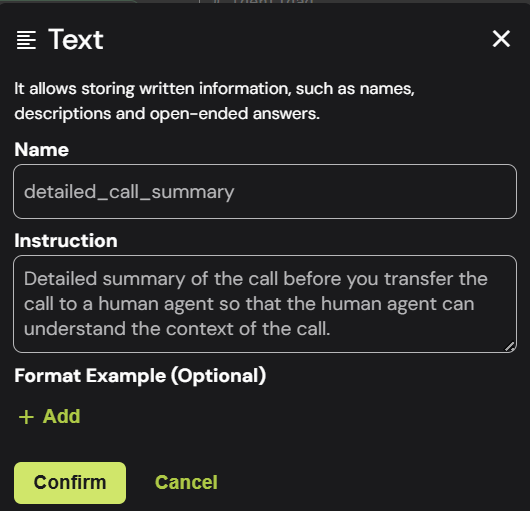
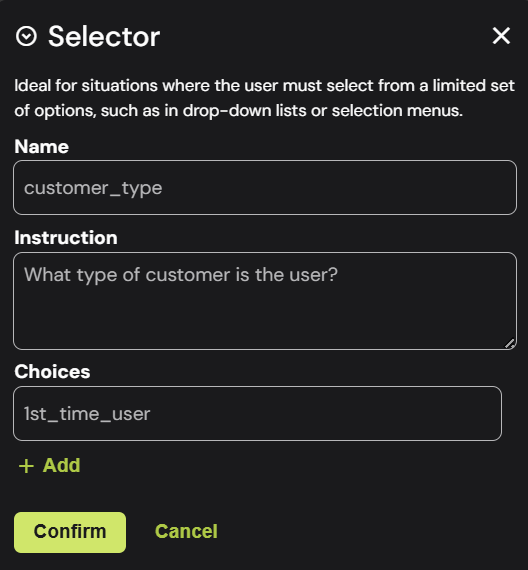
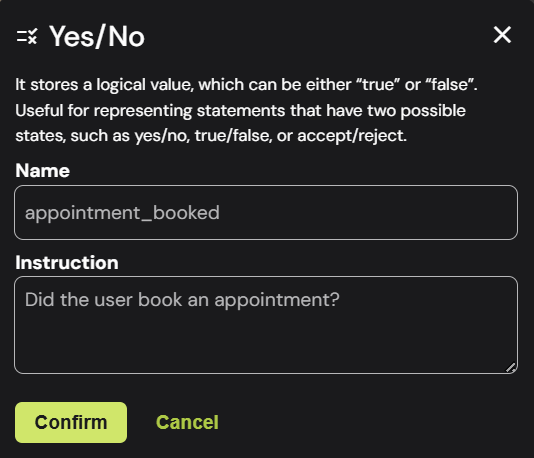
* Step 1: Give the data point a name
* Step 2: Write detailed instructions
* Step 3: Provide formatting examples (Optional)
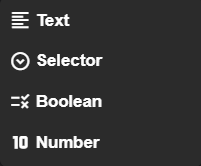
You can extract the following data types from post-call analysis:
#### Text (String):
Used to capture written, detailed information such as names, descriptions, and open-ended responses.
Example:
Call summaries, action items, or key topics discussed.
***
#### Selector (Enumeration):
Used to categorize information from a fixed list of predefined options.
Ideal when the user must choose from a limited set, such as dropdowns or selection menus.
Example:
Issue types, product categories, or resolution status.
***
#### Boolean (True/False):
Used for simple yes/no determinations.
Stores a logical value, either “true” or “false”. Useful for binary conditions like yes/no, true/false, or accept/reject.
Example:
Whether the customer answered for the first time.
***
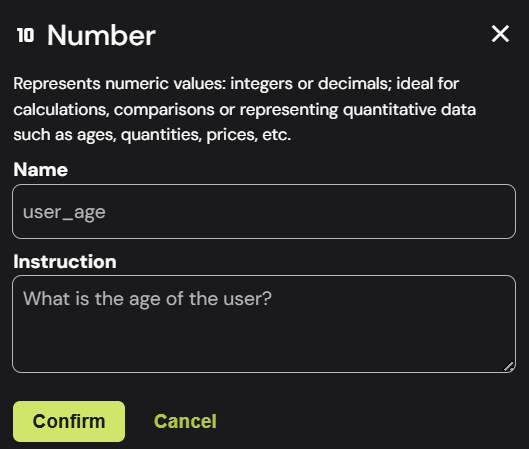
#### Number (Numeric Value):
Ideal for quantitative measurements.
Represents numeric values—integers or decimals. Great for calculations, comparisons, or representing quantitative data like ages, amounts, prices, etc.
Example:
Transaction amounts, call duration, or satisfaction scores.
---
# Agent Instructions
This documentation is published with GitBook. GitBook is the documentation platform designed so that both humans and AI agents can read, navigate, and reason over technical content effectively. Learn more at gitbook.com.
## Querying This Documentation
If you need additional information that is not directly available in this page, you can query the documentation dynamically by asking a question.
Perform an HTTP GET request on the current page URL with the `ask` query parameter, and the optional `goal` query parameter:
```
GET https://docs.dapta.ai/ai-voice-agents/how-to-set-up-your-ai-voice-agent/post-call-analysis-post-call-data-retrieval.md?ask=&goal=
```
`ask` is the immediate question: it should be specific, self-contained, and written in natural language.
`goal` is optional and describes the broader end goal you are ultimately trying to accomplish on behalf of the user. GitBook uses it to tailor the answer towards what is most useful for that goal.
The response will contain a direct answer to the question and relevant excerpts and sources from the documentation.
Use this mechanism when the answer is not explicitly present in the current page, you need clarification or additional context, or you want to retrieve related documentation sections.